
Step-by-Step Guide on How to Prepare for Exams
Preparing for an examination can be overwhelming, especially when you have multiple subjects to cover, several textbooks to read and limited time before your examination date.
For many students, exam preparation means spending long hours reading textbooks, highlighting notes and trying to memorize as much information as possible. However, studying for hours does not necessarily mean you are studying effectively.
The real goal of exam preparation is not simply to spend more time with your books. It is to understand what you are learning, identify areas where you need improvement, retain important information and develop the confidence to answer examination questions correctly.
Whether you are preparing for secondary school examinations, university tests, professional certification examinations or competitive entrance examinations, having a structured preparation strategy can make a significant difference.
The good news is that preparing for exams does not have to be complicated.
With the right study techniques, a realistic timetable, organized learning materials and consistent practice, you can make your study sessions more productive.
In this guide, we will walk you through 10 practical steps on how to prepare for exams effectively, including how AI-powered tools like Edad AI can help you plan your studies, create personalized study materials, practice with quizzes and flashcards, and manage distractions.
Let's get started.
1. Understand Your Examination and What You Need to Study
Before you start reading your textbooks, take time to understand the examination you are preparing for.
One common mistake students make is starting to study without knowing the full scope of the examination.
You might spend several hours studying a particular topic only to discover that you have neglected other important areas that will also appear in the examination.
Start by finding answers to these questions:
What subjects or courses will I be examined on?
What topics are included in the examination syllabus?
What is the examination date?
What is the format of the examination?
Which topics carry more weight?
Are there past questions or practice examinations available?
Once you have these answers, break your syllabus into smaller topics.
For example, a university student preparing for a biology examination could divide the syllabus into cell biology, genetics, ecology, human physiology and evolution.
This gives you a clearer picture of what you need to cover and prevents you from studying without direction.
Edad AI Tip:
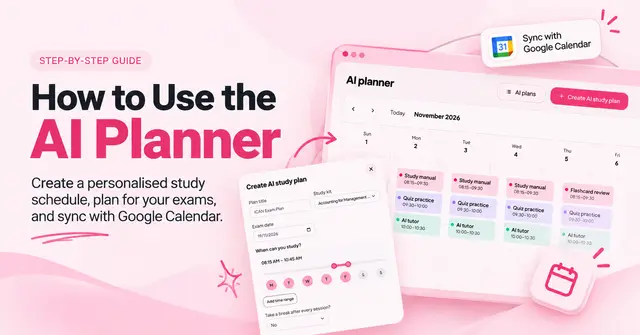
Rather than trying to organize everything manually, you can use the AI Planner on Edad AI to structure your exam preparation. By organizing your examination goals and available study time, you can create a more organized approach to covering your syllabus.
2. Evaluate Your Current Knowledge and Identify Your Weak Areas
Not every topic requires the same amount of attention.
Some topics might be easy for you because you already understand them, while others may require additional explanations, practice and revision.
This is why you should evaluate your current understanding before creating your study timetable.
Start by reviewing each topic and placing it into one of three categories:
Category | Meaning | What to do |
|---|---|---|
Strong | You understand the topic | Revise and practice occasionally |
Average | You understand some parts | Spend more time improving |
Weak | You struggle to understand it | Prioritize additional learning and practice |
You can also test yourself with a few questions before studying a topic.
The purpose is not to score highly at this stage. It is to discover what you already know and what you still need to learn.
For example, you might discover that you understand 80% of a mathematics topic but struggle with specific calculations. Instead of restarting the entire topic, you can focus your attention on those difficult areas.
This makes your preparation more targeted and productive.
3. Create a Realistic Study Timetable
One of the most important steps in preparing for exams is creating a study timetable.
Without a schedule, it is easy to spend too much time on one subject while neglecting others.
A good study timetable helps you organize your time, distribute your workload and create a consistent study routine.
Here is how to create one:
First, write down your examination dates.
Knowing when each examination will take place helps you determine how much preparation time you have.
Second, list all the subjects and topics you need to cover.
Break larger topics into smaller learning activities that can be completed within individual study sessions.
Third, allocate time based on difficulty and importance.
Subjects you find difficult may require more attention than subjects you already understand.
Fourth, include revision and practice sessions.
Do not dedicate all your time to reading new materials. Make room for quizzes, flashcards, past questions and revision.
Finally, include breaks and personal activities.
A timetable that gives you no time to rest is difficult to maintain. Build a schedule that fits your actual lifestyle.
Let Edad AI Help You Plan Your Studies
Creating a study timetable manually can become difficult when you have multiple examinations, different subjects and other responsibilities.
This is where the Edad AI Planner comes in.
Edad AI helps students organize their examination preparation with an AI-powered planning experience.
Instead of struggling to decide what to study every day, you can use the AI Planner to structure your study activities, organize your preparation and create a more manageable learning routine.
The goal is simple: spend less time wondering what to study next and more time actually learning.
4. Gather and Organize Your Study Materials
Imagine preparing for an examination without having access to the right textbooks, lecture notes or study resources.
You might understand what you need to learn but struggle to find materials that explain the topics properly.
Having access to relevant and organized study materials is essential for effective exam preparation.
Your learning materials may include:
Lecture notes and handouts.
Textbooks and recommended reading materials.
Past examination questions.
Course outlines and examination syllabuses.
Online educational resources.
Research papers and relevant study documents.
However, collecting materials is only the beginning. You also need to organize them properly.
Avoid having your learning materials scattered across different folders, websites and devices. Arrange them according to subjects and topics so you can find what you need without wasting time.
Build Your Personalized Study Kit with Edad AI
What happens when you cannot find the right material for a particular topic?
Or when your lecturer provides lengthy notes that are difficult to organize?
Edad AI makes this process easier through its AI Planner Study Kit.
With the Study Kit, you can work with learning materials gathered from the internet and upload your own study resources, such as lecture notes and documents.
This allows you to bring your learning materials together and build a more personalized study experience.
For example, a student preparing for a chemistry examination can use their lecture notes alongside relevant online study materials to organize resources for topics such as chemical bonding, acids and bases, and organic chemistry.
You don't have to depend entirely on searching through different websites or manually organizing every document.
Your study materials. Your topics. Your personalized study experience.
Always review the sources of online materials and confirm that the information matches your examination syllabus.
5. Break Large Topics into Smaller, Understandable Lessons
Looking at an entire syllabus can make studying feel overwhelming.
When you have 15 chapters to cover, it is easy to become discouraged before you even start.
The solution is to break large topics into smaller learning units.
For example, instead of writing "Study Mathematics" on your timetable, create specific tasks such as:
Understand quadratic equations.
Practice solving simultaneous equations.
Revise algebraic expressions.
Solve five questions on probability.
Review mathematical formulas.
This makes each study session more focused because you know exactly what you want to achieve.
You should also set a clear objective before every study session.
Rather than saying, "I want to study biology for two hours," try saying, "I want to understand the process of photosynthesis and answer five questions on it."
The difference is that one focuses on time spent, while the other focuses on actual learning progress.
Remember, the objective is not simply to finish your textbook. It is to understand the material well enough to apply what you have learned.
6. Use Active Learning Instead of Just Reading Your Notes
Reading your textbooks repeatedly might make information look familiar, but familiarity does not always mean understanding.
One reason students struggle during examinations is that they spend too much time reviewing information passively instead of testing their ability to remember and apply it.
This is where active learning becomes important.
Active learning involves engaging with the information rather than simply reading it.
Here are some effective techniques:
Practice active recall: After studying a topic, close your textbook and try to explain what you have learned without looking at your notes.
Teach someone else: Imagine explaining a difficult concept to someone who has never studied it before. This can help you discover whether you truly understand the topic.
Create mind maps: Connect related ideas and concepts visually to understand how different parts of a topic relate to each other.
Solve practice questions: Apply what you have learned by answering questions instead of assuming you understand a topic because you have read it.
Explain concepts in your own words: Avoid depending entirely on textbook definitions. Try to explain ideas using language you understand.
These techniques encourage you to interact with information, identify knowledge gaps and improve your ability to recall what you have studied.
7. Practice with Quizzes and Flashcards
One of the best ways to know whether you are ready for an examination is to test yourself.
You cannot confidently measure your understanding by simply reading your notes and assuming you remember everything.
You need to put your knowledge to the test.
Two useful revision tools are quizzes and flashcards.
How Quizzes Help with Exam Preparation
Quizzes allow you to test what you have learned through questions and answers.
They help you:
Evaluate your understanding of different topics.
Identify areas where you need more revision.
Become familiar with answering examination-style questions.
Monitor your learning progress.
Try taking quizzes after completing a topic rather than waiting until the entire syllabus is finished.
How Flashcards Improve Revision
Flashcards are useful for revising definitions, formulas, important concepts, dates, key terms and other information you need to remember.
One side of a flashcard contains a question or prompt, while the other contains the answer.
For example:
Question: What is photosynthesis?
Answer: The process by which green plants use sunlight to convert carbon dioxide and water into glucose and oxygen.
You can review these cards repeatedly, focusing more attention on the information you struggle to remember.
Create Your Quizzes and Flashcards with Edad AI
With Edad AI, you can generate quizzes and flashcards to support your learning and revision.
Instead of manually creating hundreds of questions and revision cards, you can use AI-powered learning tools to make your study sessions more interactive.
You can use quizzes to test your understanding and flashcards to revise important information.
The more actively you engage with what you have learned, the better you can understand your strengths and weaknesses.
8. Manage Your Time and Eliminate Distractions
You have created your timetable, gathered your study materials and identified the topics you need to cover.
But there is one problem: you keep checking your phone.
You open WhatsApp to reply to a message, spend a few minutes scrolling through Instagram, watch a TikTok video and suddenly realize that an hour has passed.
This is a common challenge for students.
Distractions can interrupt your concentration and make it difficult to complete your planned study activities.
Effective time management is therefore an important part of exam preparation.
Here are a few ways to manage distractions:
Put your phone away when studying.
Turn off unnecessary notifications.
Study in a quiet and comfortable environment.
Set specific time blocks for individual tasks.
Take short breaks between study sessions.
Avoid opening social media during your planned study time.
Meet Time Guard: Your Study Focus Companion
Sometimes, knowing that you should avoid distractions is not enough. You need a system that helps you stay accountable.
That is why Edad AI includes Time Guard.
Time Guard is designed to help students take control of their study time by restricting access to distracting applications during designated study sessions.
Instead of constantly fighting the temptation to check your phone, Time Guard helps create an environment where you can concentrate on learning.
Think about it.
When you dedicate one hour to studying, that hour should be used for studying, not switching between textbooks, WhatsApp, Instagram and TikTok.
With Time Guard, you can make your study sessions more intentional and reduce distractions that prevent you from making progress.
Your examination deserves your attention. Give it your focus.
9. Practice Past Questions and Simulate Examination Conditions
Understanding your study materials is important, but you also need to know how to apply that knowledge during an actual examination.
This is why practicing past questions and examination-style exercises should be part of your preparation.
Past questions can help you become familiar with the examination format, understand how questions are presented and identify topics that require additional attention.
However, don't just memorize past questions and their answers.
Focus on understanding the concepts behind the questions so that you can answer unfamiliar questions that test the same knowledge.
Try this approach:
Select a past question paper or practice examination.
Set a timer based on the actual examination duration.
Answer the questions without checking your notes.
Review your answers when you finish.
Identify mistakes and revisit the relevant topics.
Repeat the process with another practice paper.
This helps you improve your ability to manage time, interpret questions and work under examination conditions.
If you get a question wrong, don't just memorize the correct answer. Understand why your original answer was incorrect.
That is how practice becomes meaningful.
10. Take Care of Your Health and Prepare for Examination Day
Preparing for exams is not only about reading and answering questions.
Your physical and mental well-being also matter.
Some students believe that staying awake all night before an examination is a sign of commitment. However, consistently sacrificing sleep can leave you tired, distracted and less prepared to concentrate.
As your examination approaches, prioritize:
Getting adequate sleep.
Eating balanced meals.
Drinking enough water.
Taking breaks during long study sessions.
Avoiding unnecessary all-night study sessions.
Revising important concepts without overwhelming yourself.
On the day before your examination, focus on reviewing important information rather than attempting to learn the entire syllabus from scratch.
Prepare your examination materials, confirm your examination time and location, and get enough rest.
On examination day, arrive early, read the instructions carefully, manage your time and approach each question calmly.
Remember, your preparation should help you walk into the examination hall with confidence.
How Edad AI Makes Exam Preparation Easier
Preparing for an examination involves several activities: planning your study sessions, finding learning materials, understanding difficult topics, revising information, testing your knowledge and managing distractions.
Doing all these things manually can become overwhelming.
This is why Edad AI brings important parts of the exam preparation process into one AI-powered learning platform.
Here is how it helps:
Edad AI Feature | How It Helps Students |
|---|---|
AI Planner | Helps organize study activities and create a personalized study schedule. |
AI Planner Study Kit | Helps students work with relevant online learning materials and their own uploaded notes and documents. |
AI Quizzes | Helps students test their knowledge and identify areas requiring more practice. |
AI Flashcards | Makes it easier to revise definitions, concepts, formulas and important information. |
Time Guard | Helps reduce distractions by restricting access to other applications during study sessions. |
Rather than juggling different tools for every stage of your preparation, Edad AI gives you a more organized way to approach learning.
Whether you are preparing for a university examination, secondary school test or professional certification, you can use these tools to make your study sessions more structured and productive.
A Sample 7-Day Study Plan for Examination Preparation
Not sure how to put everything into practice?
Here is a simple seven-day study plan you can adapt to your examination schedule.
Day | Study Activities | Main Objective |
|---|---|---|
Day 1 | Review your syllabus and identify weak topics. | Understand what you need to study. |
Day 2 | Study two difficult topics and create revision notes. | Build understanding. |
Day 3 | Study new topics and revise previously covered lessons. | Reinforce learning. |
Day 4 | Practice quizzes and create flashcards. | Test your knowledge. |
Day 5 | Review weak areas and solve past questions. | Improve understanding and application. |
Day 6 | Take a timed practice examination. | Improve examination readiness. |
Day 7 | Review mistakes, revise key concepts and rest. | Consolidate learning and prepare for the exam. |
You can adjust this schedule depending on the number of subjects, examination dates and how much time you have available.
For a longer preparation period, repeat the process while gradually increasing the difficulty of your practice questions and revisiting previously studied topics.
You can also use the Edad AI Planner to organize your study activities around your available time.
Frequently Asked Questions About Exam Preparation
1. What is the best way to prepare for exams?
The best way to prepare for exams is to create a realistic study timetable, understand your syllabus, organize your study materials, use active learning techniques, practice past questions and consistently revise what you have learned. Avoid relying entirely on last-minute reading.
2. How many hours should I study for an exam?
There is no fixed number of hours that works for every student. Your study time depends on the examination, the difficulty of the subjects, your existing knowledge and how much time you have before the examination. Focus on productive study sessions and measurable learning progress rather than simply counting hours.
3. How can I remember what I study?
Use active recall, flashcards, practice quizzes and spaced revision. Instead of repeatedly reading the same information, challenge yourself to remember and explain what you have learned without looking at your notes.
4. How can I create a study timetable for exams?
Start by listing your examination dates, subjects and topics. Allocate study sessions based on topic difficulty and importance, include time for revision and practice, and leave room for breaks. An AI-powered study planner like Edad AI can help you organize your preparation.
5. How do I avoid distractions when studying?
Put your phone away, turn off unnecessary notifications, choose a quiet environment and set dedicated study periods. You can also use Edad AI's Time Guard to help restrict access to distracting applications during your study sessions.
6. Can AI help me prepare for examinations?
Yes. AI can support exam preparation by helping students organize learning activities, work with study materials, generate quizzes and flashcards, and manage their study routines. However, students should actively review and understand the information rather than depend entirely on AI-generated answers.
7. What should I do one day before an examination?
Review important concepts, revisit difficult topics, practice a few questions, organize your examination materials and get enough sleep. Avoid attempting to cover the entire syllabus at the last minute.
8. Is Edad AI useful for university and professional examinations?
Edad AI is designed to support students and professionals preparing for examinations through features such as its AI Planner, Study Kit, quizzes, flashcards and Time Guard. These tools can help users organize their learning and make revision more structured.
Final Thoughts: Prepare Smarter, Not Just Longer
Passing an examination is not just about how many hours you spend reading. It is about how effectively you use the time available to you.
A well-organized study plan, access to relevant learning materials, consistent revision, regular self-testing and proper time management can make your preparation more effective.
Start early. Understand your syllabus. Identify your weak areas. Create a realistic study timetable. Practice consistently and protect your study time from distractions.
And remember, you don't have to figure everything out manually.
Edad AI is here to help you plan better, study smarter and prepare with confidence.
Why spend hours wondering what to study next when you can have a more organized way to learn?
Start preparing smarter today with Edad AI.
Visit www.edadai.com and take control of your exam preparation.
Edad AI Learn Without Limits.
Additional Reading and Learning Resources
For students who want to explore evidence-based study techniques further:
Both resources discuss active recall, self-testing and other approaches that can help students make their study sessions more effective.